Jira Change History: Full Configuration State, Captured Over Time
Why having a complete, time-stamped record of your Jira configuration changes is a game-changer for proactive management, troubleshooting, and long-term health.
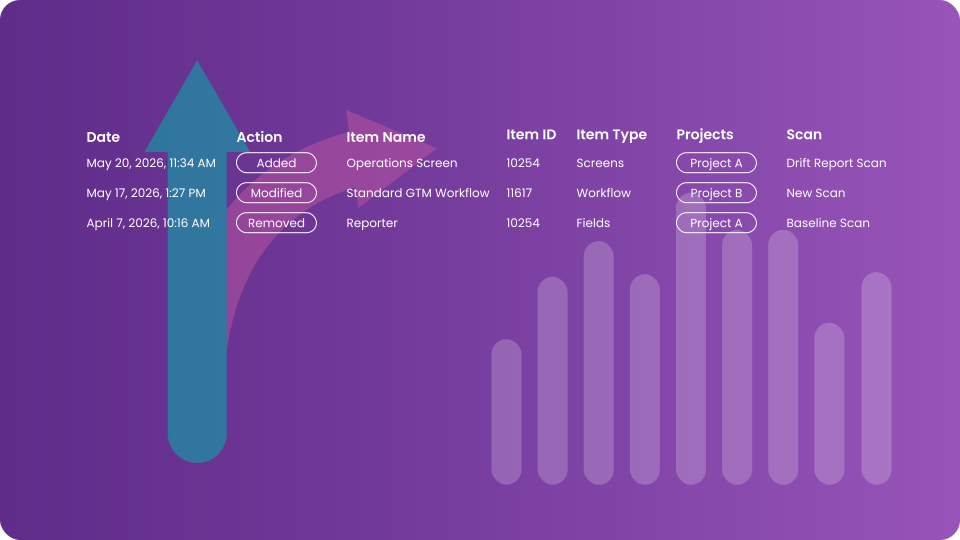
To truly understand and manage your Jira Cloud configuration you need what Jira has never offered on its own: a complete, comparable record of how your instances have changed over time, with every previous state available and the consequential changes surfaced automatically.
This is the foundation for proactive governance. Learn how Solcoro's Change History feature can transform your approach to Jira configuration management.
Change History
Change History captures the full configuration state of your Jira instance on a schedule you control: daily, weekly, or monthly. Each capture is a complete snapshot, not a partial diff, which means every prior state of your instance is preserved and available for comparison.
Because Solcoro holds those prior states and understands the configuration context of your instance, it can do three things a standard audit log cannot:
- Compare across time. See exactly what moved between any two captures, at the level of workflows, statuses, fields, screens, schemes, and permissions.
- Weight by consequence. Distinguish a cosmetic edit from a change that breaks something downstream, and alert on the ones that matter rather than burying them in a flat list.
- Deliver the signal to you. Surface consequential drift through the channels you already work in, so you do not have to log in and hunt for the one entry that counts.
The result is a shift from reactive to proactive. Instead of discovering a configuration problem days later by tracing a symptom back to its cause, you are told at the moment the change becomes risky, while it is still cheap to fix.
Next, let's get into where this all matters most.
Scenario 1: DevSecOps and the Disappearing Quality Gate
The setup. A regulated engineering org enforces a workflow condition: no issue can transition to "Done" without QA sign-off. That condition is a control. It is also part of what auditors check.
What drifts. During a routine workflow cleanup, an admin removes a condition they believe is redundant. It was not. The QA sign-off gate is now gone. Nothing breaks. Tickets still move, boards still render, no alarm fires.
Before Change History. The deletion is one line in the audit log, indistinguishable from two hundred other entries that week. For three weeks, untested work transitions straight to "Done" and ships. The gap surfaces only when something fails in production that QA never saw, or worse, when an auditor finds it. Now it is an incident and a compliance finding, not a fix.
With Change History.The next scheduled capture compares against the prior state, recognizes that a transition control was removed from a workflow tied to your delivery process, and flags it as consequential. You get an alert the same day, naming the workflow, the transition, and exactly what was removed. You restore the condition before a single untested issue ships.
Scenario 2: Agile data roll-up and the corrupted status category
The setup. Leadership reviews delivery health from dashboards that aggregate across dozens of projects: velocity, sprint completion, throughput. Every one of those numbers depends on status categories being correct, because "Done" in the reporting sense is defined by a status's category, not its name.
What drifts. An admin creates a new status, "Ready for Review," and assigns it to the "Done" category, a common mistake when the intent is just to mark work as ready to hand off. The status is then added to a workflow shared across twenty projects. Every issue that lands in "Ready for Review" now counts as complete in any report that aggregates those projects.
Before Change History. Nothing looks broken. No tickets pile up, no one is locked out. But every roll-up that touches that workflow now overcounts completed work, because issues waiting for review are being scored as done. Velocity inflates, sprint completion looks healthier than it is, and leadership steers off numbers that are quietly wrong. By the time someone questions the data, three sprints of reporting are unreliable and the decisions made on them are already in motion.
With Change History.Solcoro sees that a new status with a "Done" category was introduced into a shared workflow between captures, and understands that this propagates into every board and report referencing that workflow. It flags the change as high-consequence and names the status, its category, and the workflow it entered. You correct it before the next leadership review reads from inflated data.
Scenario 3: Service Management and the Broken Process
The setup. A service desk runs on automation. Incoming requests auto-assign to the right queue by component the moment they are created, so nothing lands unowned and SLAs start ticking against a real assignee. The desk works because that rule runs on every new request.
What drifts. During a cleanup of unused automation, an admin disables the auto-assignment rule, believing it is no longer needed. It is a single toggle, easy to make and easy to overlook.
Before Change History. New requests stop auto-assigning. Nothing throws an error. The queue simply fills with unassigned requests while everyone assumes the desk is running as usual. The first real signal is a missed SLA or an escalation from a stakeholder asking why no one responded, by which point the backlog is real and the trust damage is done.
With Change History.Solcoro detects that an automation rule was disabled between captures, recognizes that it drives assignment for a live service desk, and alerts you that a running process is at risk. You re-enable the rule before the queue backs up or a single SLA breaches.
One Capability Across Every Configuration Domain
These three scenarios share a structure, and so does almost every configuration incident: a small, low-visibility change with a large, delayed consequence. DevSecOps controls, agile reporting, service management, they all break the same way.
Change History addresses all of them with one mechanism. Full configuration state, captured on a schedule, with every previous state preserved and consequential drift surfaced automatically across workflows, statuses, fields, screens, schemes, and permissions. Whatever changed, Solcoro saw the state before it, sees the state after it, and can tell you whether it matters.
This is what it means to govern an instance rather than excavate it. Change History is available now.